A New Statue in Waterloo Place

People tend to walk past statues in London, not look at them. That changed a little while ago when Banksy added some street art to the collection of statues to be found in Waterloo Place (just before you reach the Grand Old Duke of York overlooking the Mall).
I suppose most people were just very excited to have stumbled upon “a Banksy”, but hopefully a few of them, perhaps on their way home later, began to think about what the statue was trying to say.
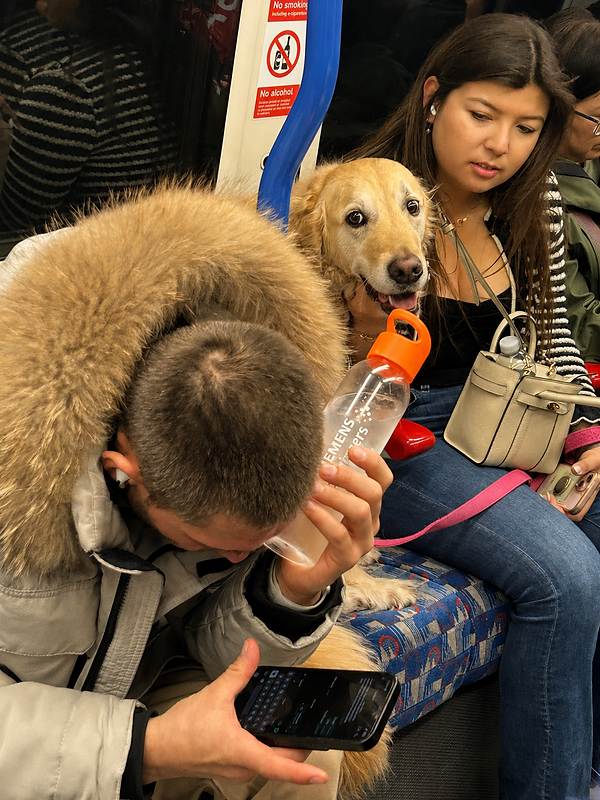
I didn’t at first, because on the tube I had the good luck to meet a very friendly dog.
London is a great town for dogs because there are so many fantastic parks to run around in.

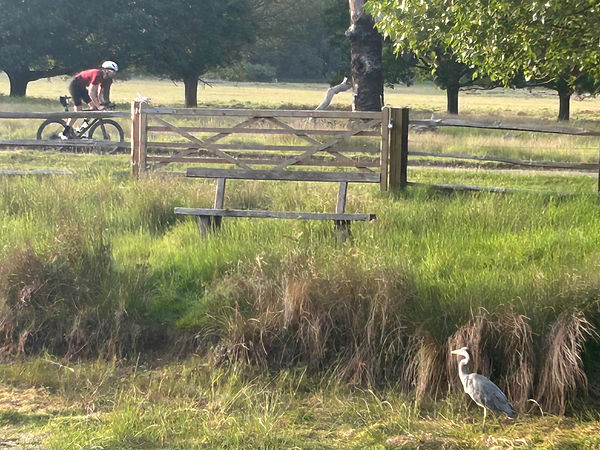
This is the view from Richmond Park, south-west of the city.

It is England’s “green and pleasant land” only a tube ride away.

Which these feet can easily walk upon thanks to the tube.

And so back to Banksy.

As I walked past Banksy’s new monument to British folly one evening, I was interested to notice the other statues who were looking on. Athena, the Goddess of Wisdom, watched from her perch above the entrance of the scaffold-entombed Athenaeum Club on one side of Waterloo Place . . .

. . . while Britain’s great icon of heroic failure, Scott of the Antarctic, gazed stoically from the other. It must have been put up in a hurry, but Banksy’s statue could not have been better positioned.
Aces High at the Cinema Museum

Yesterday I attended a 50th-anniversary screening of Aces High at that treasure-trove of British film culture, the Cinema Museum in Kennington. It was wonderful to have a chance to hear the reminiscences of two of its stars, Peter Firth and David Wood, but as memorable a part of the evening was the extraordinary venue.

As I gazed up at the iron girders that held up the great wooden ceiling of the old workhouse chapel where the film was screened, I couldn’t help thinking that it would be a great spot from which to suspend a Sopwith Camel.

The 9.30 Train

The point about 9.30 a.m. is that it marks the end of peak time on the suburban rail network around London. It’s when you often find children, just after the rush hour, herded by their teachers on to trains for day trips into central London. This makes it a risky time for straggling commuters.
I was on the 9.30 train this morning. I was buried in Kafka’s The Trial when suddenly I hear a great scream. “Oh my God! What have you done??” It sounded like someone had just been murdered. I looked up to see a woman with her skirt soaking in coffee. There was a large puddle surrounding her feet. “It’s all over me!! I’ve got a very important meeting this morning!”
Opposite her, with a half-guilty smile and suppressing a giggle, stood the 8-year-old girl who had upset a beaker on to the woman’s lap. A teacher arrived to try to help out but was badly scolded. “It’s not OK!” the woman said angrily. “You shouldn’t have been letting her run around.”
But the commuter’s decency soon returned – it’s hard not to forgive an 8-year-old no matter how much coffee has been spilt – and the school staff were doing their very best to make up, supplying her with endless tissues.
It had been a big cup of coffee. And I’m afraid I found it very funny, which I suppose is why I’m writing about it now. I wonder how her meeting went.
There but for the grace of God... My clothes were dry. But it could as easily have been me.
The London School

The British Library. Surely one of the most likeable, friendly buildings in London. So solid and generous in its design. When I was passing through the atrium yesterday on my way up to one of the reading-rooms, I was thinking about the old painting that it reminded me of. But then I saw the giant tapestry If Not, Not hanging on the wall.
I once worked with R. B. Kitaj, the painter of the original picture on which the tapestry is based. The book Conversations with Kitaj was published to coincide with an exhibition of his work at the Tate Gallery in 1994. The merciless treatment of the exhibition from the critics was such that Kitaj later decided to leave Britain, where he had lived most of his adult life.
Luckily we were still ignorant then of what lay ahead. I guess that at about the same time as I was seeing him in Chelsea, the weavers in Edinburgh would have been getting to work on the tapestry, which, for me, is such an inseparable part of visiting the British Library.
Kitaj’s kindness and resolve to do whatever he could to create a beautiful book made our brief collaboration a very satisfying experience. Perhaps it helped that he was a big movie fan. We didn’t talk about the film then, but it’s interesting for me now to read in Michael Powell’s memoirs that Kitaj told Powell that The Red Shoes changed his direction in life when he saw it as a teenager growing up in the US: “It gave art new meaning to me.”
The other thing that impressed me about Kitaj was the combination of gentleness and determination. Not long before we met, he had suffered a heart attack. I remember him telling me how part of his recovery routine involved regularly walking from his studio in Chelsea to the National Gallery, where he would study the Old Masters.

Savile Row

In Savile Row there’s usually a knot of tourists standing outside the old Apple building trying to imagine the music coming from the roof more than fifty years ago. If they had been able to get back to 1969, however, they would have found that the police were very quickly on the scene to silence the band. Not that they had to come very far.

The station is only a short walk down the road. It’s abandoned now and somebody seems to have stolen the blue lamp that used to hang over the street corner. But you can still find a few fashion police arguing over style in the Sartoria restaurant over the road by the big gallery, where, I suppose, the hedge fund managers, who now occupy this part of Mayfair, buy much of their art.

But the bit of the past that means most to me is actually just beyond Savile Row in Vigo Street – the little house, next to the Albany, which provided Penguin with their first home. By the time I got to work for them, they were housed in a modern office building next to High Street Kensington tube station, which looked like a tin can. So every time I pass 8 Vigo Street, I think how much more pleasant it would have been to work there – and then.

Last Christmas, the Row decked the street with a splendid set of decorations. In their occupational need to keep up with fashion, I suppose there'll be a new set for us to enjoy next Christmas.
The Fulham Road

I’d been writing about Carol Reed, and I happened to be in the area, having visited a friend who lived in Redcliffe Place. So as it was a warm, sunny evening, I decided to take a walk up the Fulham Road and past some old haunts. I would cut through to the King’s Road, via Elm Park Gardens, and then take a photo of the blue plaque on Reed’s old house.
It had been a while since I had been in that neck of the woods. The Fulham Road I knew had long gone. No more Pan Bookshop in Cavaye Place, no more Gillon Aitken (a literary agent I once did some reading for), who had moved his office there from Fernshaw Road. And no more Fulham Road ABC. It was sad to see the grand old building, empty and flagless, the sound and fury long gone, with its bare marquee now signifying nothing.
It was here that I had one of my more memorable cinema-going experiences, when I went to see The Exorcist with Henrietta Moraes. She was drinking again. The situation, which I ought to have handled better than I did, was much more terrifying than anything I saw on the screen that afternoon.

Henrietta was a great fan of Carol Reed’s films, so I think she would have been pleased to learn that, by one of those quirks of film-making, her resting place in West Brompton cemetery very likely features in The Third Man. Someone who had worked on the film – I think, Bob Dunbar – told me that the cemetery was used to provide a back projection plate. And I think that if you look very carefully, you can see the Victorian terraced housing that used to overlook the cemetery (on the railway side) in the background when Major Calloway gives Holly Martins a lift in his jeep to the airport. In the end, of course, Martins decides to get out of the jeep to wait for Anna, who walks on and out of his life (as Henrietta, drunk on Pernod, walked out of mine).

After reaching the King’s Road – a bustling, happening place, buoyant with the energy of youth and money – the first landmark I reached was the Everyman Chelsea. I was amused to read later online, as I took a 22 bus home, a Secret London promotion for the opening of the cinema back in 2020. “The flagship cinema will have the usual comforts you’d associate with an Everyman cinema,” the advertorial promised. “The venue was built at a cost of £15 million, so no expense has been spared – starting with a gorgeous bar and lounge in the foyer. This is where you’ll be ordering wine and food to be delivered to your seat, which would be the highlight of the Everyman experience, were it not for those insanely comfortable seats the chain is known for.” Remembering the rather uncomfortable but bracing seats of the wonderful original cinema in Hampstead, I couldn’t help feeling, not for the first time, that the chain had become everything that the Everyman I knew wasn’t.
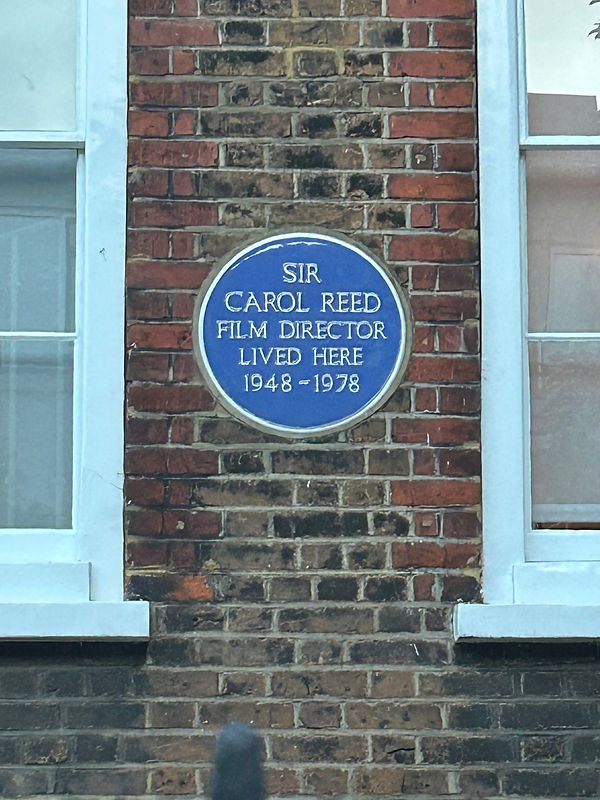
And on I walked up the road, as far as number 213, with that curious blue plaque, which generously bestows two extra years of life on the house’s famous former resident.

One of the great things about Carol Reed was his love of animals, who often feature in his films. Think of the parrot that nips Holly Martins in The Third Man, or the visit to London Zoo in The Fallen Idol, or Fagin’s owl in Oliver! So this seems to be a good place to introduce a very friendly dog, whom I met the other evening in Woodhayes Road on his way for a run-around on Wimbledon Common.
It occurs to me now that there is a dog, of course, in Oliver! – Bill Sikes’ dog, Bull’s Eye, who offers an animal representation of his owner’s violence. But Reed would have respected animals too much to want to portray a dog in that way. So it is David Lean’s depiction of Bull’s Eye that one most remembers – the kind of terrifying depiction of trembling, naked violence that Reed would have shied away from. In The Third Man, it is Harry Lime’s charm that we notice, not so much his evil.
Stirling Mansions, Canfield Gardens, NW6
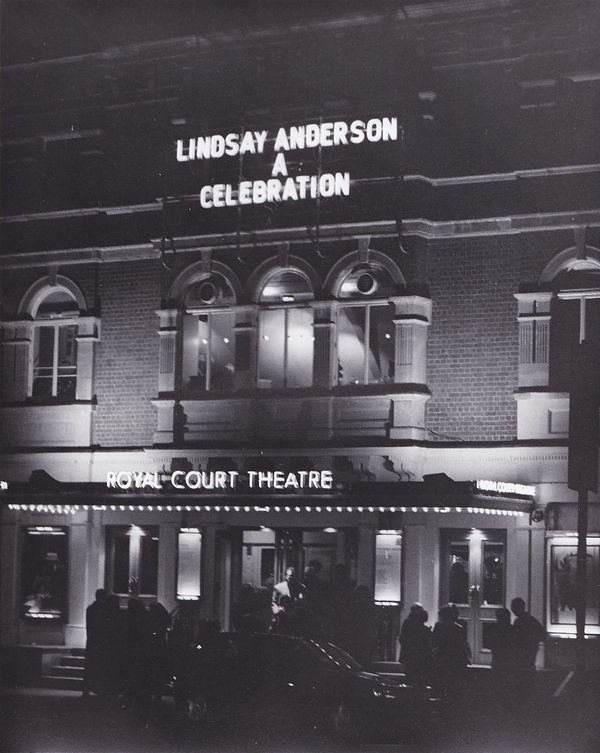
If you walk past Carol Reed’s old house at 213 King’s Road and continue on up to Sloane Square at the very end, you’ll come to the Royal Court Theatre. I took this old photograph of what it looked like on the evening of 20 November 1994. Theatreland had gathered to pay tribute to Lindsay Anderson, who had died earlier that year. If his spiritual home was certainly the Royal Court Theatre, his real home for many years was in West Hampstead. What a pleasure it used to be to get a note from him with that handwritten letterhead:

Two years later, his friends and admirers gathered outside Stirling Mansions to celebrate the unveiling of a plaque in his memory.

David Storey had just pulled the cord to open the curtains that hid it. We were all too respectful of the occasion to criticise, but had Lindsay been in the crowd I’m sure he would not have been short of ideas for how to improve it.

He would surely have pointed out the missing four dots in the title of his most well-known film, and, as someone who mistrusted institutions, he would probably also have taken exception to the words beneath the frame. But perhaps it is the words that are the biggest problem. Too many for a plaque on a wall.
As it has become rather rusty now, it would be nice one day to replace it with a simple round one like Sir Carol’s. All it would need to say would be: “Lindsay Anderson, theatre and film director, lived here 1977 to 1994”.
Or like Joseph Losey’s. Round, blue, ceramic. Simple.

Hottest May Day in London Ever

While Holland Park is very well known, much less known but every bit as welcome on a hot day is Holland Gardens, which can be entered from Pepys Road in Wimbledon.

Here you can sit down on a bench, play a bit of tennis, admire the flowers, or even learn a few fascinating facts about the natural world that we are destroying.
Brompton Cemetery

There are some fantastic stories in Brompton Cemetery. Here’s one of them: Aces High stuff.

Early in the morning of Monday 7 June 1915, Flight Sub-Lieutenant Reginald Warnefield, R.N., attacked a Zeppelin near Brussels at a height of about 6,000 feet. He dropped six bombs on the airship, which exploded, causing his Morane-Saulnier Type L to flip upside down. He managed to wrestle the plane back on to its wheels before making a forced landing behind enemy lines. Repairing the plane, he then successfully re-started the engine, yelling, "Give my regards to the Kaiser!" as pursuing German soldiers failed to catch him when he took off again. For the exploit he won the Victoria Cross, but was killed only two weeks later.

As I left the cemetery, I saw this notice in the window of the telephone box by the entrance, making it quite clear to any ghosts who might be thinking to haunt the borough that they won’t be able to call for a taxi.
Say It With Flowers

These “flowers” I owe to the wonderful Cottenham Park allotments where I have been spending many a Sunday afternoon. The rhubarb had been growing wildly. Suddenly it occurred to me that, in the bright sun of the heat wave, I could take a good photograph and then eat it. Cooked with a little bit of honey, it was delicious.

Robin Hood Gate

The word “paradise” comes from an ancient Greek word, παράδεισος, which referred to the enclosed parks of the Persian kings. So Richmond Park, a royal park, is, I suppose, the closest you can come to paradise in south-west London – although Kew, Bushy Park and Hampton Court must be close contenders.
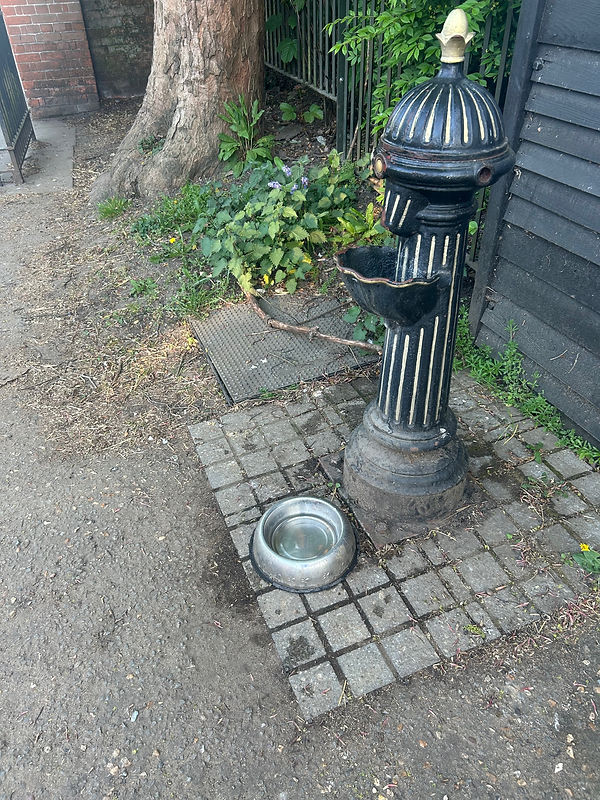
Whenever I visit, I usually enter by Robin Hood Gate. Just inside, there’s a drinking fountain, which captures for me the benign, welcoming nature of the place.
Only a short walk away, near Attenborough Pond, is a favourite bench. It sits in its own enclosure – a paradise within a paradise. Its gate was padlocked when I last visited, I assume, to allow some peace for the wildlife visitors.
There is an inscription on the top wooden rail, which is so faded now that most people don't realize that it is even there. But five years ago, it was still just possible to make out the words.

“It’s not what you look at that matters; it’s what you see.”
Monica in Merton

Coombe Lane, in Raynes Park, is perhaps the last place I would expect to find Monica Vitti, but here she is bringing a bit of new life and style to the neighbourhood.
The Chelsea Arts Club

The great thing about being an artist is that you can bring a bit of imagination and style when it comes to painting your own building – here, the Chelsea Arts Club in Old Church Street. All that needs to be done now is to send someone one up in a hot-air balloon to paint the real sky.
Southside Common

King’s College School marks the point at which the south side and the west side of Wimbledon Common meet. Which is why it was so extraordinary to see – at this time of year when the children have already been back at school for several weeks – a plentiful supply of conkers lying unclaimed beneath the trees. And even more astonishing to see, within easy reach and still dangling from their branches, some notably aged horse chestnut capsules, split invitingly open to reveal the shiny conkers within.

I could not resist adding this pair to my collection. Such a sight would have been unthinkable when I was growing up. A vivid memory from my 1960s childhood was every autumn scouring the ground along the avenue of horse chestnut trees in Golders Hill Park, hoping to find some conkers that the hordes of other children hadn’t already carried off.
There was as fierce a competition to fight with them as there was to find them. Back then a conker attached to a length of knotted string would have been a common thing to find in the pockets of British schoolboys.

But it was no surprise that big business should seek to commercialize the phenomenon. I can date the ending of my childhood to about the autumn of 1971, which coincided with a sudden craze for pairs of giant plastic marbles on string that clacked together. Although they were all the rage for one brief conker season, the marketing people missed the point, as they always do, that the best things in life are free – that we should celebrate the weeds as much as the flowers.
